In the shadow of the Royal Library of Belgium in Brussels, an extraordinary collection of over four hundred fairground ephemera recently surfaced at a vintage poster shop. This historical trove comprises an assortment of advertisements from the funfair season in the city of Leuven, providing a vivid glimpse into the world of popular visual and performance culture around 1900.
These fragile documents shed light on many facets of fairground culture during that time, including the promotion of attractions and personalities (Fig. 2), the variety of spectacles, and the overall organization of the fairs. Through the collaborative efforts of the SciFair team at the University of Antwerp and the KU Leuven Libraries, these remarkable source materials will soon be made available for both public enjoyment and academic research.
A rare find
A cornerstone of historical research on the fairground involves identifying and delving into city archives, museum catalogues, and private collections. Online databases and repositories have also become indispensable tools for locating and analysing relevant sources and to access materials remotely. Additionally, online auction sites offer opportunities to discover historical artefacts and documents that may not be found through traditional archival channels, broadening the reach of historical investigation. Nonetheless, it is worth venturing into the private market beyond the online and institutional channels as well.
This was the case for the rare find of ephemera at Ma Maison de Papier. Established in 1968 as Brussels’s first dealer specializing in vintage posters and ephemera, the shop offers a diverse collection of original posters, prints, illustrated sheet music, vintage magazines, and more. Since 1979, owner Marie-Laurence Bernard has specialized in popular visual culture, with a focus on Belgian Art Nouveau posters. She has contributed to national and international museum collections and exhibitions and generously shares her knowledge with researchers. It was during an engaging conversation with Marie-Laurence that the fund of fairground ephemera came on the SciFair radar. When she presented several dozen fairground flyers, we were left overwhelmed by the sheer volume and diversity.


Flyers up for grabs
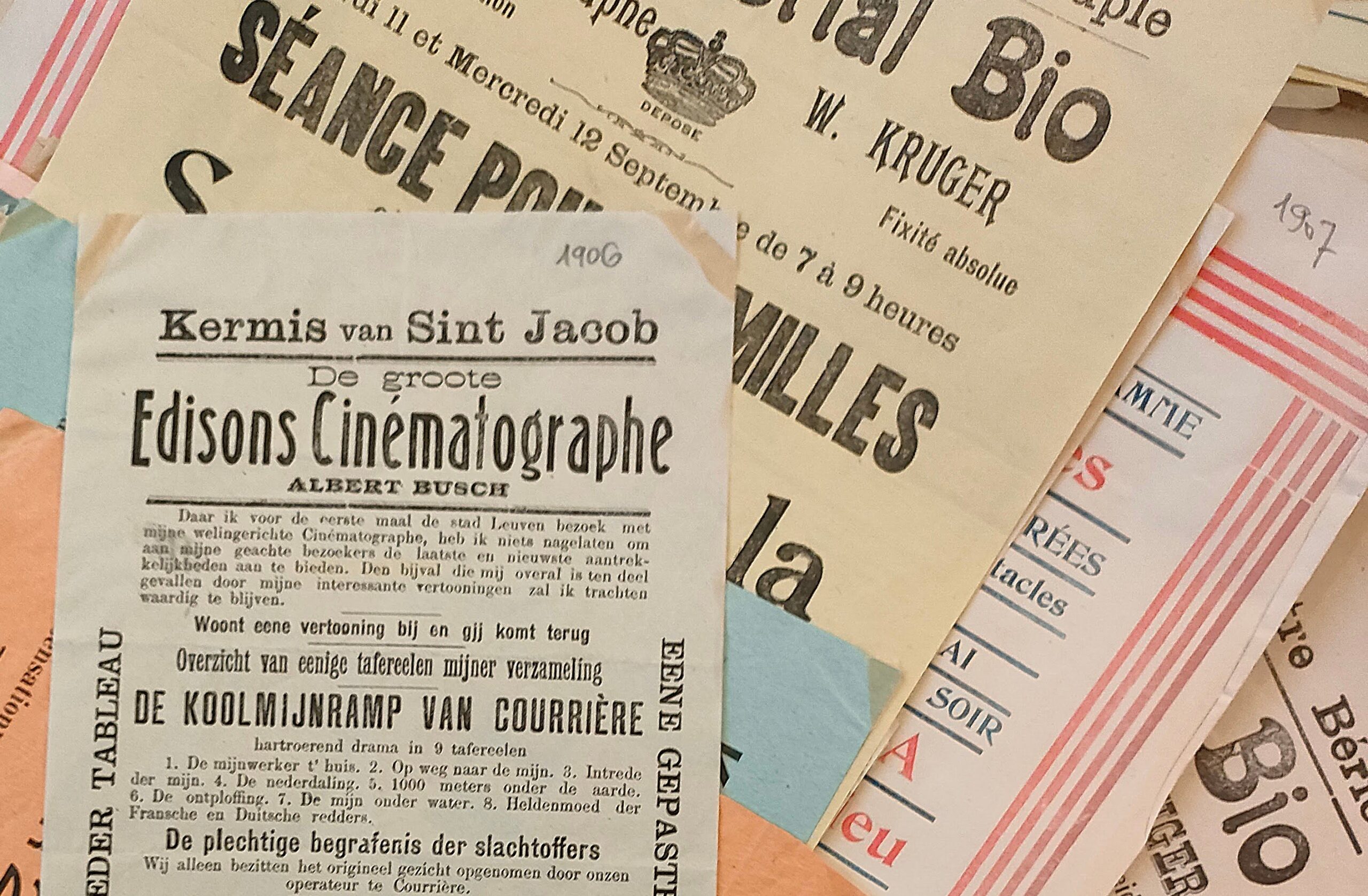
These wafer-thin advertising flyers, produced by travelling show people, served as promotional instruments to lure visitors to their attractions. Printed on inexpensive and low-quality paper, they feature persuasive language, bold typography, and vibrant designs — colours that have since largely faded with time. While most of these materials went adrift in the tides of daily life — discarded, tattered, or simply carried away by the wind in the open (as their names in French and Dutch suggest: ‘pièces volantes’ or ‘vliegende bladen’) — and have no intrinsic monetary value, they provide essential insights into the world of nineteenth- and early-twentieth-century fairground culture (Fig. 3).
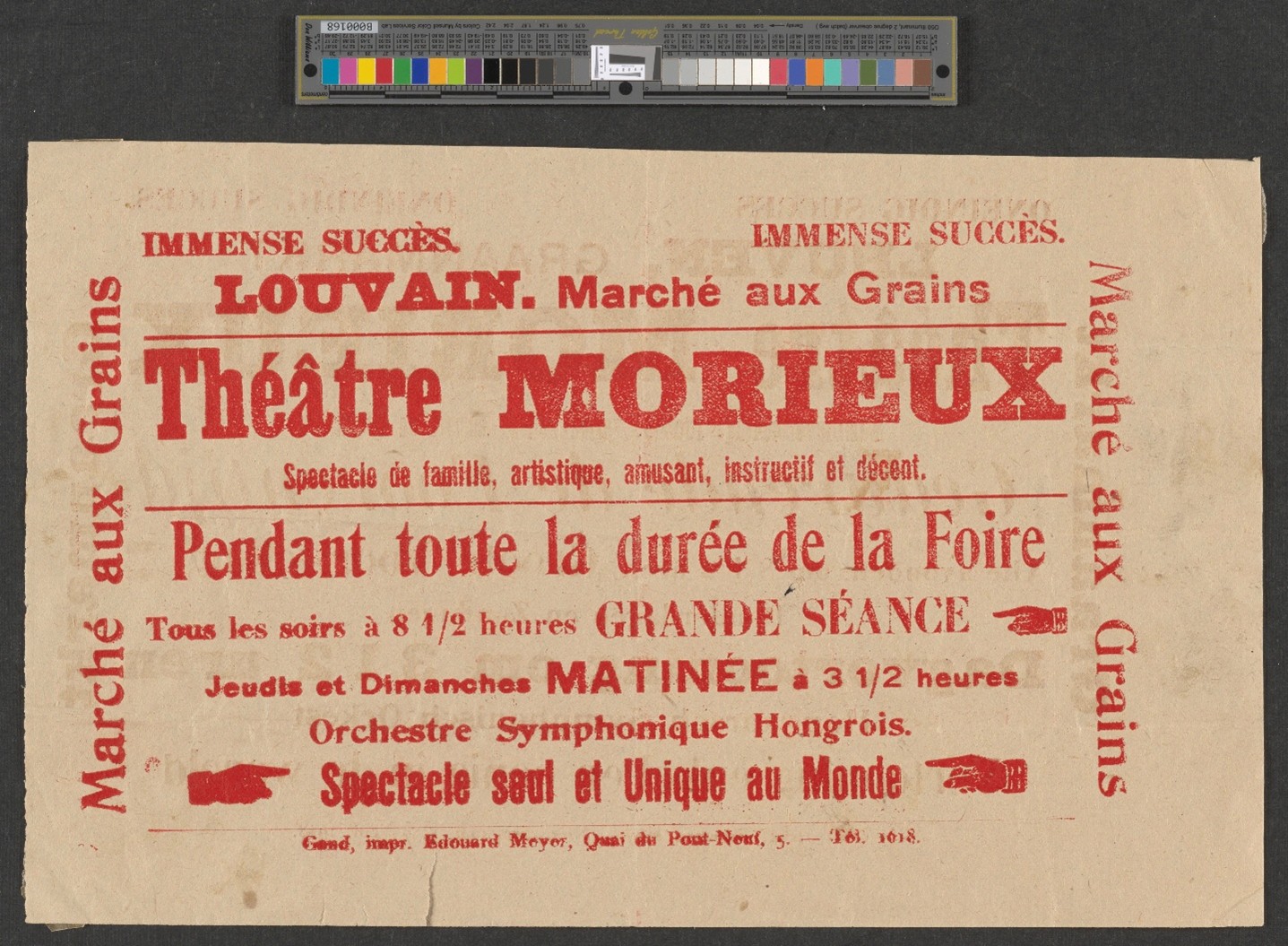
The content of these flyers reveals details about attractions, programmes, dates, and locations; and reflect the promotional strategies of the time. They illustrate how showpeople and attraction owners presented themselves and their offerings. Unsurprisingly, this came with a flair for exaggeration: Attractions were described as unprecedented, never-before-seen, or available for a final, once-in-a-lifetime viewing. One such example is a small flyer of the renowned Morieux Theatre that has been researched in depth by Erkki Huhtamo hailed as an immense success and “a spectacle unique in the world” (Fig. 4). So, historians must remain critically aware of their intended purpose: to draw in large crowd.
Collections of fairground ephemera

Ephemera form a vital resource for studying the fairground as a social and cultural phenomenon. While comprehensive collections remain scarce, several reference collections can be found in institutions, such as the Museum of European and Mediterranean Civilisations in Marseille, the Stadtgeschichtliches Museum in Leipzig, and the Ghent University Library. The extensive collection of the latter, the so-called ‘vliegende bladen’ (flying leaflets), is diverse in content and form. It owes its origins to Ferdinand Vander Haeghen, head librarian at the Ghent University Library from 1868 to 1911, who began collecting ‘pièces volantes’ as early as 1859. Vander Haeghen’s broad definition of ephemera led to the inclusion of a wide range of materials beyond occasional prints. By the time he left the library, the collection reportedly comprised 740,000 pieces. Today, it holds more than one million items, including materials from Ghent and other Flemish cities and towns, as well as some from beyond national borders.
Though its exact provenance remains unknown, the recently discovered fund in Brussels is likely to have originated from a private collector. Although it also contains several types of documents and a variety of subjects related to the city of Leuven, it is particularly noteworthy for its focus on early cinema attractions, enriching existing collections both thematically and geographically (Fig. 5).
From private collection to public access
The SciFair team immediately recognized the importance of securing this valuable historical collection to serve both public interest and the advancement of historical research. Through the mediation of our colleague Prof. Kaat Wils, from the Cultural History since 1750 research group at KU Leuven, these fragments of Leuven’s cultural heritage were acquired by Special Collections at the KU Leuven Libraries. Meanwhile, the library undertook a meticulous process of cataloguing, packaging, and digitizing the documents at KU Leuven’s Imaging Lab, preserving the fund both physically and digitally. SciFair’s expertise will now enrich the metadata, ensuring these materials are accessible through both SciFair’s online database and KU Leuven Libraries’ own catalogue.
By integrating archival research, digital tools, and market resources, researchers can explore and scrutinize historical materials. This multifaceted approach highlights the value of cooperation between academic institutions and the private market; and emphasizes the role of networks and shared awareness in safeguarding cultural heritage. The commitment of Marie-Laurence Bernard, whose knowledge and passion held the collection together over the years, deserves special recognition. Regrettably, Ma Maison de Papier, a haven for enthusiasts of historic prints, will close its doors in December 2025. Nevertheless, through the joint dedication of SciFair and the KU Leuven Libraries, these leaflets, symbolizing the fleeting moments of the ephemeral fairgrounds, are well-preserved and soon accessible for research and public enjoyment.
- Bernard, Marie-Laurence. 1989. Armand Rassenfosse : Affiches et Illustrations. Brussels: s.n.
- Bernard, Marie-Laurence, Nicole Walch, and Godelieve Denhaene. 2005. Smaken En Geneugten : Restauratie van Affiches Uit de Verzamelingen van de Koninklijke Bibliotheek van België. Brussels: KBR.
- Huhtamo, Erkki. 2019. “Mechanisms in the Mist: A Media Archaeological Excavation of the Mechanical Theater.” In Media Archaeology and Intermedial Performance. Deep Time of the Theatre, edited by Nele Wynants, 23–82. Cham: Palgrave Macmillan.
Want to see more of these wonderful fairground ephemera? Keep an eye on the Science at the Fair database and KU Leuven Libraries’ discovery platform Digital Heritage Online to access these captivating materials soon: